Shetland Islands
The SwarmThe Shetland Islands serve as a meeting point between marine research and the expanding ocean crisis. At the edge of the continental shelf, they are a place from which researchers look toward poorly understood deep water; on land, a small station gives Sigur Johanson and Karen Weaver a chance to meet. The tsunami then erases that familiar foothold. For Johanson and Weaver, the islands become not simply a location but the memory of a catastrophe they survived together.
At the edge of the continental shelf
The islands sit within a maritime landscape shaped by the contrast between shallow shelf and deep ocean. The continental shelf is the submerged continuation of the land’s continental plate, generally no more than two hundred metres deep; beyond its edge, the seabed slopes toward the ocean floor. The novel presents the depths beyond the shelf as a realm far less familiar to science than outer space. This distinction matters to the Shetland episodes: the islands are a landmark in a world where the sea can quickly become difficult to read, and the research activity around them points outward toward that uncertain underwater territory.
North of the Shetland Islands, the research vessel Thorvaldson has passed beyond the continental shelf. Nearly seven hundred metres of water separate its keel from the seabed, and the charted slope gives way to a zone whose darkness remains mysterious. The ship’s powerful lights can reveal only small patches, like a streetlamp illuminating a country at night. The scene makes the islands a threshold rather than a boundary that guarantees safety: beyond the shelf, human knowledge and visibility become sharply limited.
The wider seascape reinforces that vulnerability. At sea, water and sky can merge without visual markers; rain and dark waves blur the horizon until it offers little sense of direction or scale. Even near the islands, rigs that might otherwise serve as landmarks can be hidden by drizzle or lie too far away to see. The Shetland setting therefore joins solid geographic reference points to a maritime environment capable of dissolving them.
The research station and Johanson’s arrival
The islands become a meeting place after Karen Weaver writes to Johanson. Recently returned to London, she says she cannot contact Lukas Bauer or find out what has happened to him and his boat. She proposes that she and Johanson meet, offering the Shetlands as an earlier alternative to her London office because she is heading there. The invitation connects the islands to the investigation into Bauer’s disappearance and brings Johanson into direct contact with Weaver.
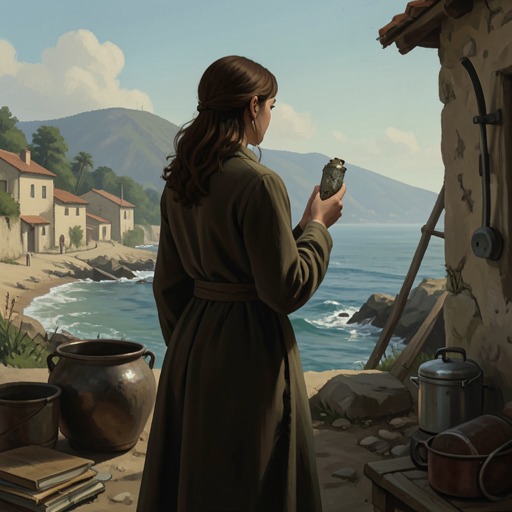
The meeting takes place at a marine research station on the island. Its helipad is a rough circle of gravel surrounded by grey-green moorland, and its crooked, wind-battered huts house about half a dozen scientists. A narrow road descends from the hills to a jetty; two jeeps and a rusty Volkswagen bus stand by the buildings. The small station feels far removed from a major scientific centre, but it is an active workplace rather than an empty refuge. Weaver lives in one of the huts, accompanies the scientists on expeditions, joins their research dives, and is working on an article about seals.
Johanson arrives by helicopter after flying over cliffs and along the coastline toward the landing field. To the east, the cliffs slope down to a broad bay, where sand and pebble beaches divide the water from barren moorland and long hills crossed by roads. The aircraft lands with a jolt on the gravel. Johanson climbs down, glad to be back on firm ground, and Weaver comes to meet him in the wind. The everyday particulars of the station and arrival establish a human-scale setting just before the disaster makes that scale irrelevant.
The tsunami and the loss of the station
When the tsunami reaches the Shetland coast, the station’s isolation becomes perilous. Johanson and Weaver escape in the helicopter, scraping over the crest of the wave. From the climbing aircraft, they can see the coast below: a powerful tide continues forward and swallows the land. The station, its vehicles, and a scientist have vanished. Farther away, fountains of spray burst above the cliffs and rise toward the clouds. The scene replaces the station’s modest, recognizable features—the huts, road, vehicles, and landing place—with a coastline transformed by water.
The wave’s scale is explained through the movement of the seabed and the water above it. As the continental shelf and slope slide downward, the sea level falls across a vast area; water around the descending mass rises and surges outward. Near the slide, across thousands of square kilometres, the wave is so flat that it goes unnoticed in the storm and rises scarcely a metre above the sea. It becomes dangerous when it reaches shallow shelf water. This account gives the Shetland destruction a connection to a much larger geological process: what appears locally as a sudden inundation has travelled outward from the changing ocean floor.
The helicopter escape does not make the islands a place of uncomplicated rescue. The station and those left on the coast are lost as Johanson and Weaver survive above the wave. The difference between their airborne escape and the disappearance below is stark; the island’s research outpost cannot protect its occupants from a disaster arriving through the sea on which their work depends.
A shared memory of survival
The Shetland escape recurs later as a personal point of reference. Before Weaver leaves in a submersible, she embraces Johanson and remembers their escape from the tsunami there. Her recollection gives the islands a place in their relationship: the catastrophe is no longer only a large-scale event but also a shared experience that shapes the weight of their parting. She believes they will see each other again, even as the immediate circumstances leave that hope uncertain.
The location’s narrative significance rests on this double function. The Shetlands first offer a practical reason for Johanson and Weaver to meet, with a research station suited to Weaver’s work and close to the sea under investigation. They then become the scene of a sudden, immense loss, demonstrating how little the land’s apparent solidity can guarantee against oceanic forces. Remembered afterward, the islands hold both the violence of the tsunami and the human bond formed in surviving it.